The Europa 1964 stamp issue was the last one released by Group Captain W.H. Cliff. It was issued on 14 September 1964 and Susan Faed and family took over the lease of Jethou on 29 September 29, 1964. The island was then in disrepair, and the family had more urgent things to do than planning future stamp issues. Thus, no stamps were issued in 1965.
However Susan Faed kept the postal service running, and as the year 1966 came around, a new issue was contemplated to commemorate the Norman Year, the 900th anniversary of the Battle of Hastings that brought the Duchy of Normandy (including the Channel Islands) within the British sphere. She commissioned Charles Coker to propose designs for the new stamp issue to be released on 14 October 1966 and she decided to revert to Guernsey Lithoprint Ltd. to print the stamps. The set was to include four values, and Coker came up with six design proposals, including two that were not retained.
Unfortunately the original designs are not in my collection, but they were illustrated in Backman and Forrester’s “The Postage Stamps of the Smaller Channel Islands” (1981, 2008) and in an article published in the magazine Stamp Collecting on 2 July 1981. The original sketches by Charles Coker provide four face values: 2d., 3d., 4d. and 6d. As we will see the final issue consisted in 3d., 6d., 1 shilling and 1 shilling 9 pence. Coker’s original idea for the 3d. value was to show a Norman ship “as depicted on the Bayeux tapestry”, according to Backman and Forrester. Let’s now compare the original ship on the Bayeux tapestry, the two sketches prepared by Coker and the issued 3d. stamp (Figure 1).
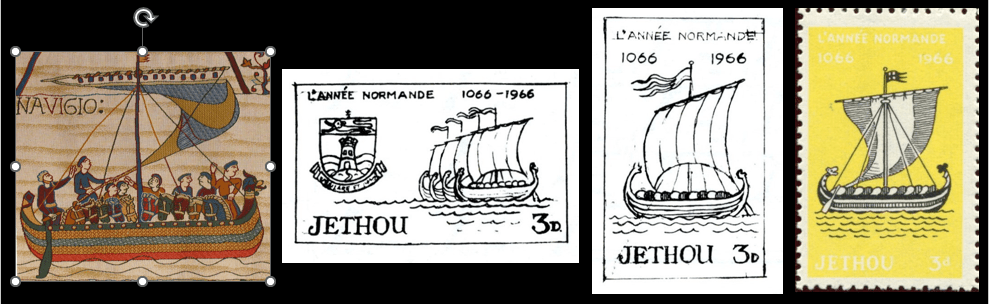 Figure 1
Coker proposed a horizontal and a vertical design. The horizonal design shows four ships and as we will see, it was retained for the 1-Shilling value. The vertical one shows only one ship, but although the ship in Coker’s sketch is similar to the original from the Bayeux tapestry, it differs from the issued design. The vertical format was retained but on the sketch the flag flows towards the left whereas on the issued stamp it flows to the right, as on the Bayeux tapestry. On the sketch there are 10 shields lining the boat but 12 on the issued stamp. The overall appearance of the ship on the issued stamp is closer to the original on the tapestry. It is unfortunate that the final background colour was yellow, especially as the proofs were also printed in orange which allowed the lettering to stand out much better.
The second stamp of the set shows the arms of William the Conqueror and of Jethou. It had a face value of 6d. and Charles Coker’s sketch proposed a face value of 4d. It shows a Norman helmet, shield and sword (Figure 2) and as can be seen from the picture, his rendition was quite faithful to the originals. We must remember that it was 30 years before the internet, so Coker probably searched books and encyclopaedias to document his drawings. Eventually Mrs. Faed chose to show two coats of arms and for the first time, Jethou’s motto was written correctly: “Vigilare et admonere”.
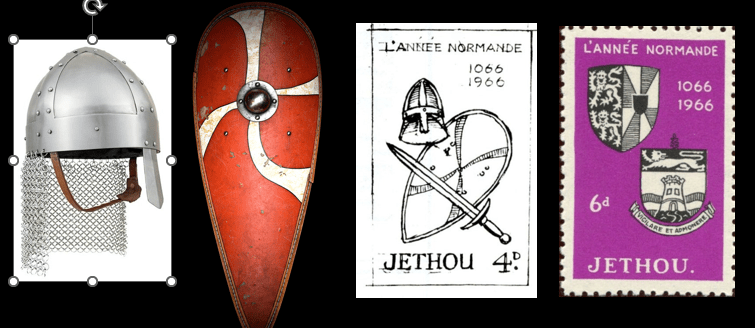 Figure 2
The third value in the set was 1 Shilling, but Coker’s sketch shows a face value of 3d. The issued design is strikingly similar to his sketch, the main differences being the shape and colours of the ships’ sails and Jethou’s crest and motto (Figure 3).
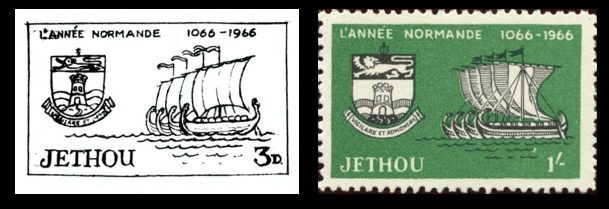 Figure 3
The fourth and last value of the set was 1 shilling 9 pence and here again the issued stamp is strikingly similar to Coker’s preliminary sketch, showing an outline of Jethou and a Norman soldier in full garb (Figure 4). Apart from the face value, the other major differences are the island, which is shown in much more detail on the issued stamp and the placement of the years 1066 – 1966 beside the soldier.
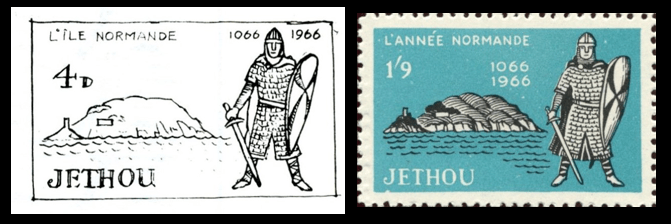 Figure 4
Two of Charles Coker’s designs were not retained (Figure 5), and they both show an invading Norman soldier wielding a sword, the outlines of Norman ships and, on one of the sketches, Jethou’s arms with incorrect motto.
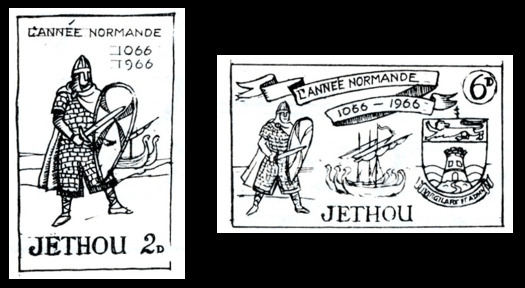 Figure 5
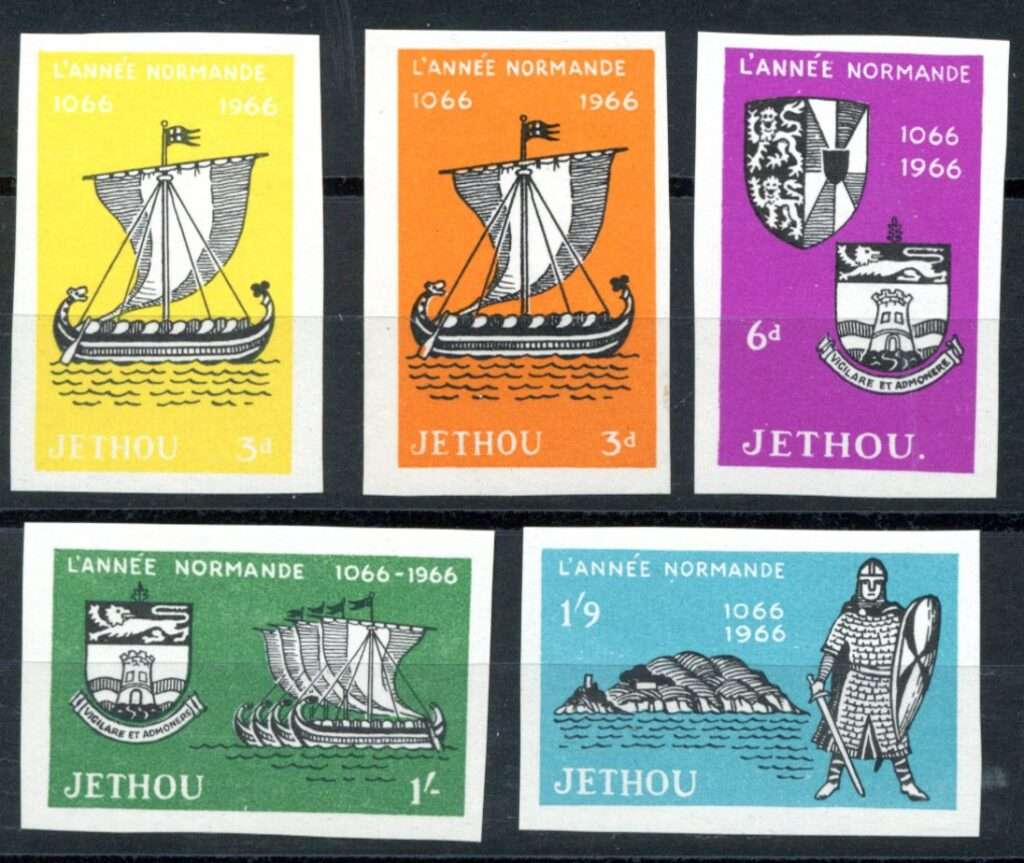 Figure 6
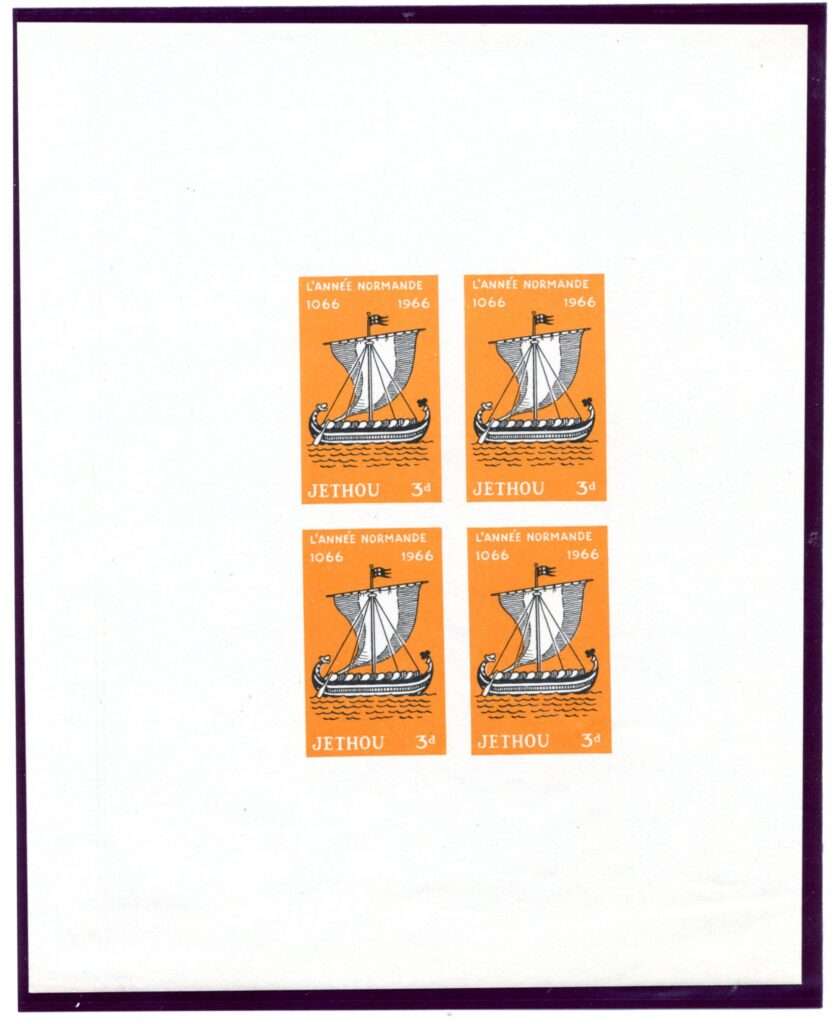 Figure 7
Once Susan Faed had approved the final designs, proofs were prepared and submitted to her by Guernsey Lithoprint Ltd. They exist as singles (Figure 6) as well as imperforate sheetlets of four (Figure 7) and large compound sheets of 4 blocks of 4, both perforated and imperforate, with the 3d. value either yellow or orange (Figure 8) (Figures 9 and 10 online). Imperforate proofs in background colours only also exit (Figure 11).
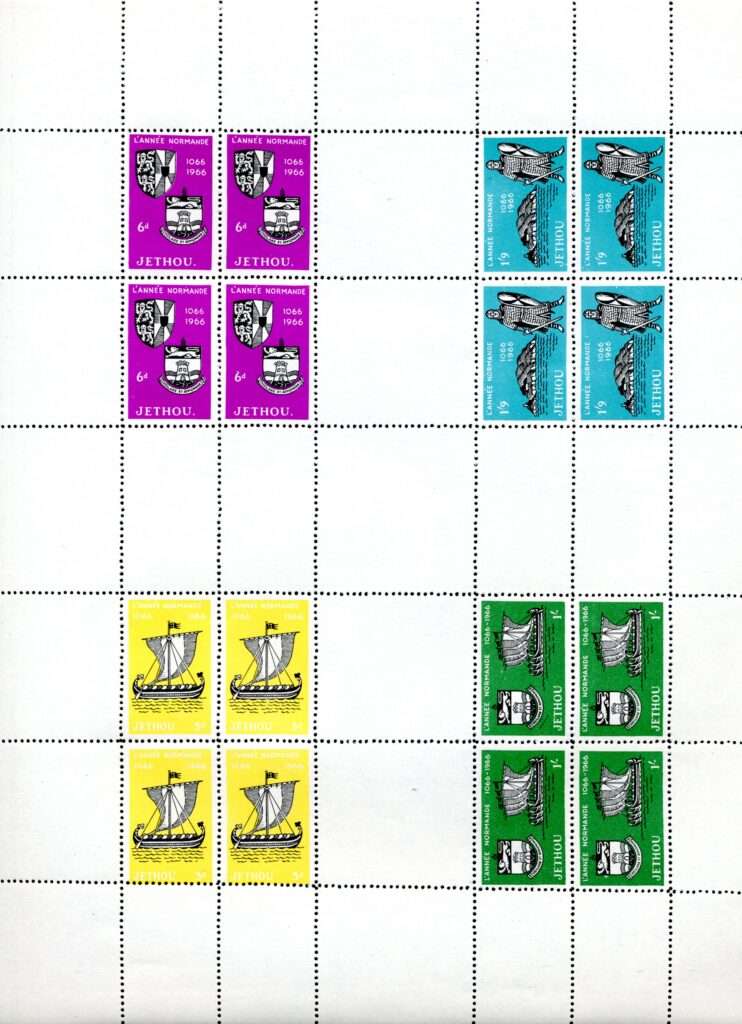 Figure 8
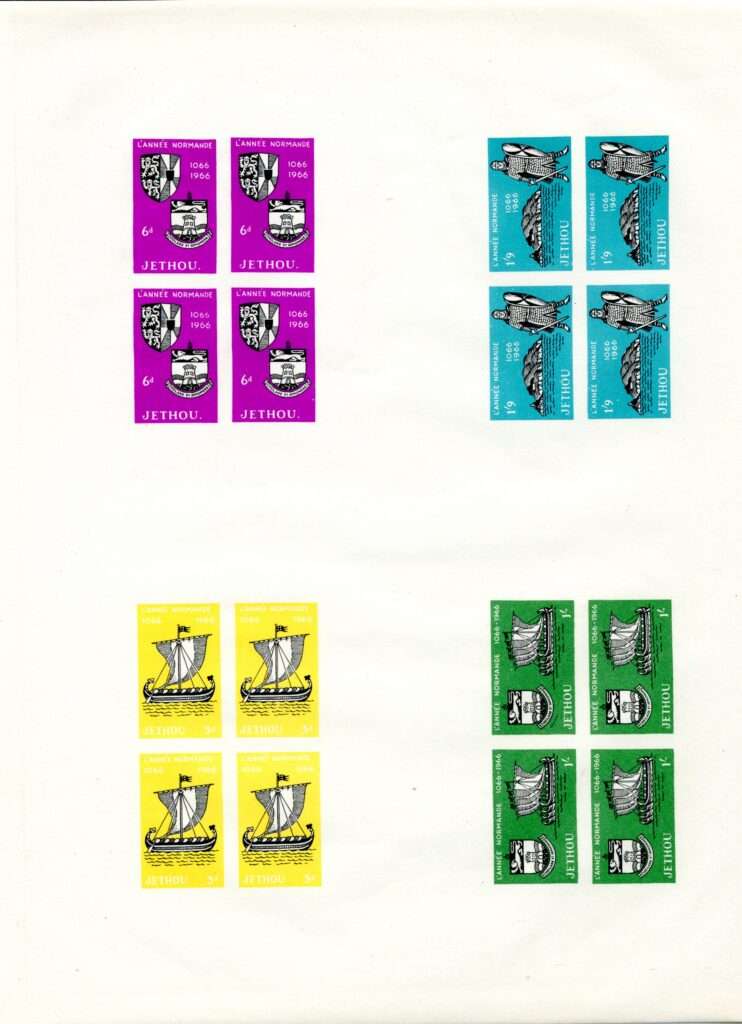 Figure 9
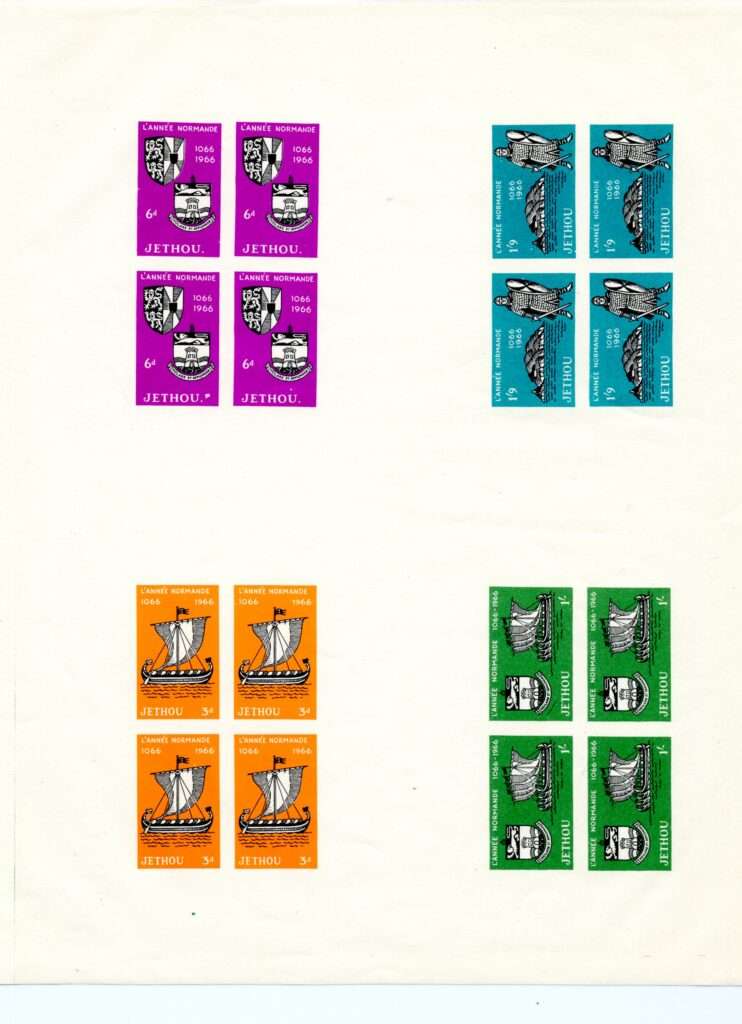 Figure 10
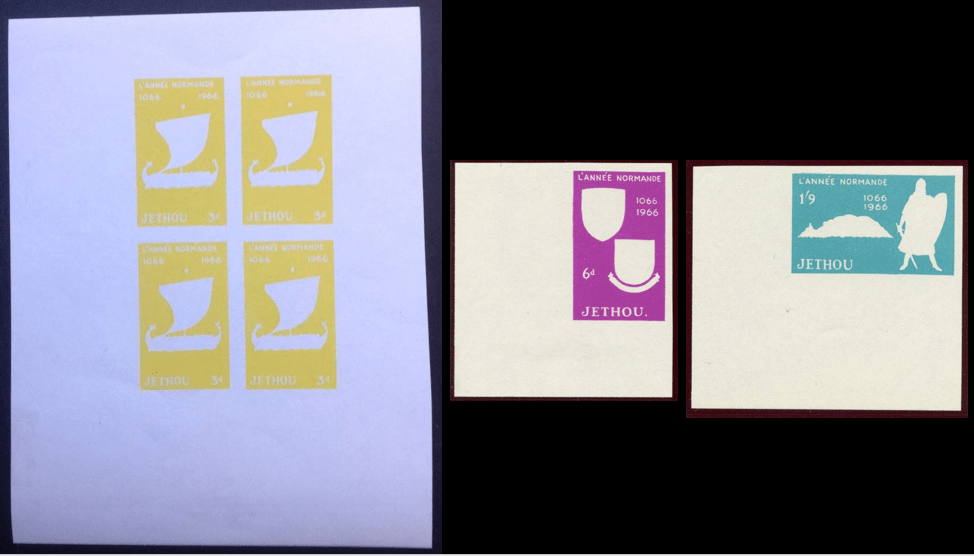 Figure 11
Backman and Forrester write that “Apart from a few sheets of the 1s. which are without horizontal perforations the printers appear to have had no trouble with the production of the issue”. In fact, many part-perforated sheets of all values have come onto the market, and they could be either proofs or printer’s waste (Figure 12).
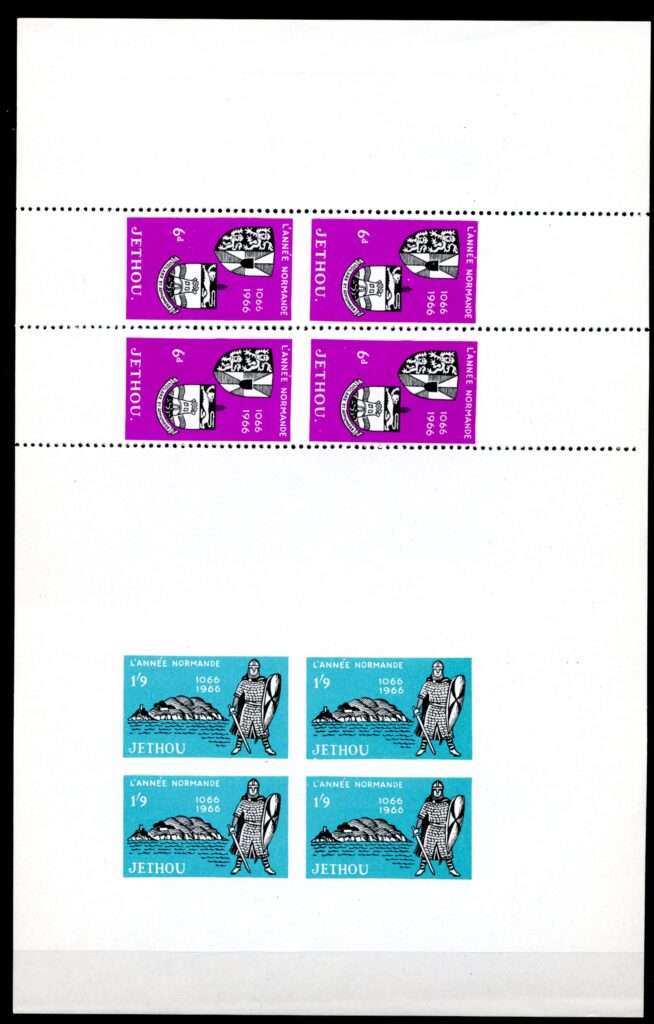 Figure 12
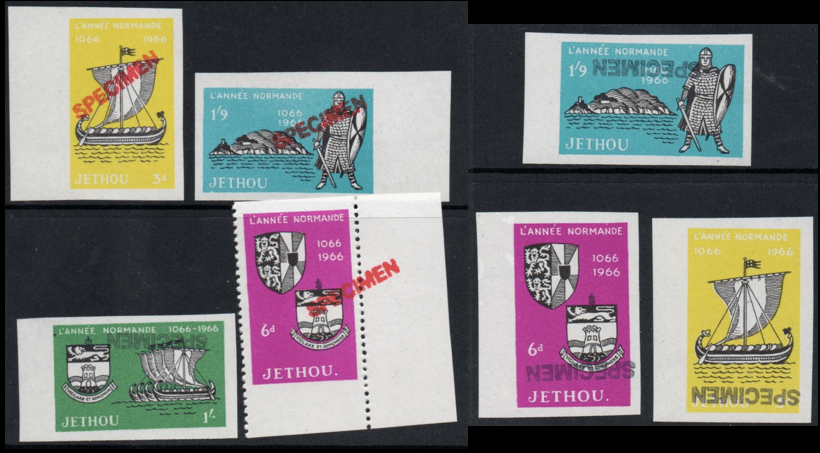 Figure 13
Recently, imperforate values of this set have appeared on Delcampe with a handstamped “SPECIMEN” overprint in black or red, both upright and inverted. They are bogus (Figure 13). Backman and Forrester state that only 48 imperforate copies of each value exist. If it is true, one wonders who would want to spoil these rare stamps with a bogus overprint.
This short study would be incomplete without a word about the miniature sheet that was issued at the same time as the stamps. Even though the printing run was very low (just 500 copies), it was not popular and it did not sell well.
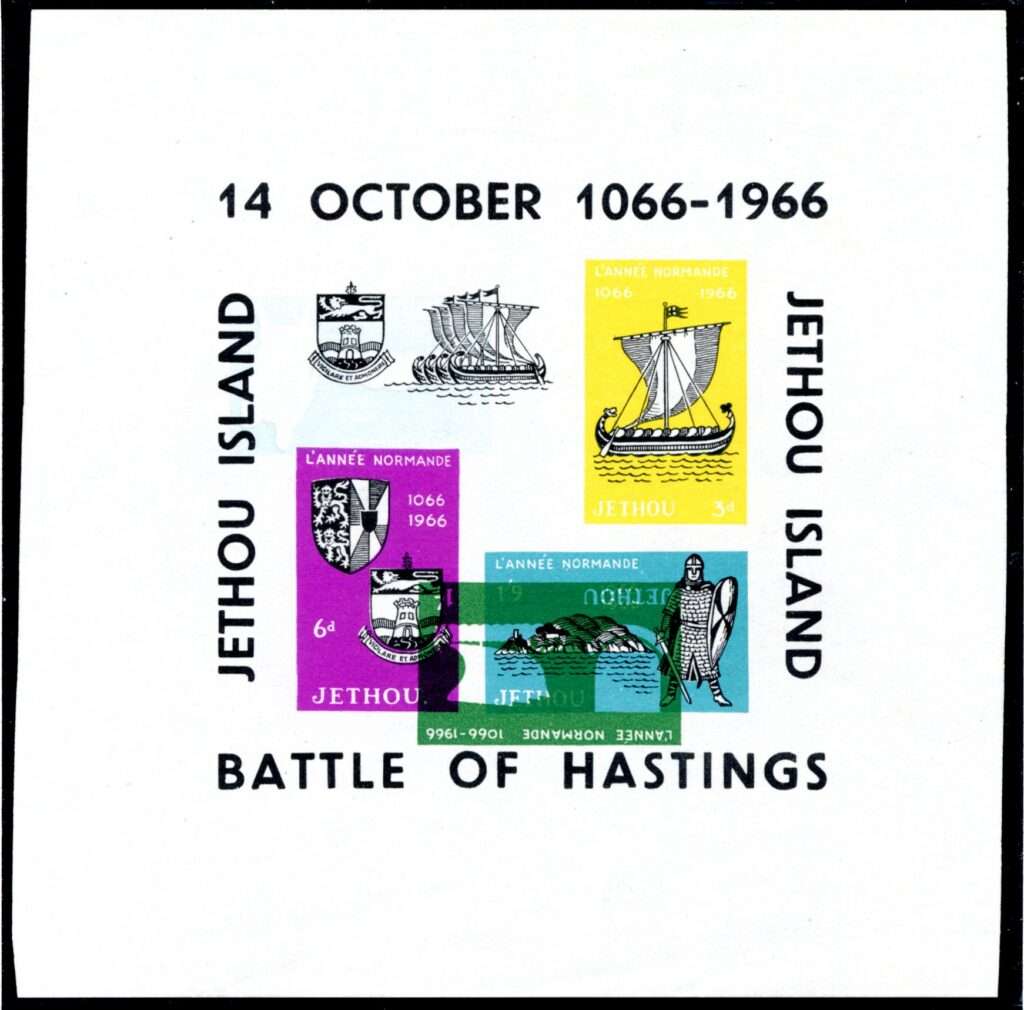
There are proofs of this sheet in the adopted colours but with the green colour misplaced (Figure 14 below) or with the 3d. stamp in orange (Figure 15 online) and with the green colour almost completely missing (Figure 16 online).
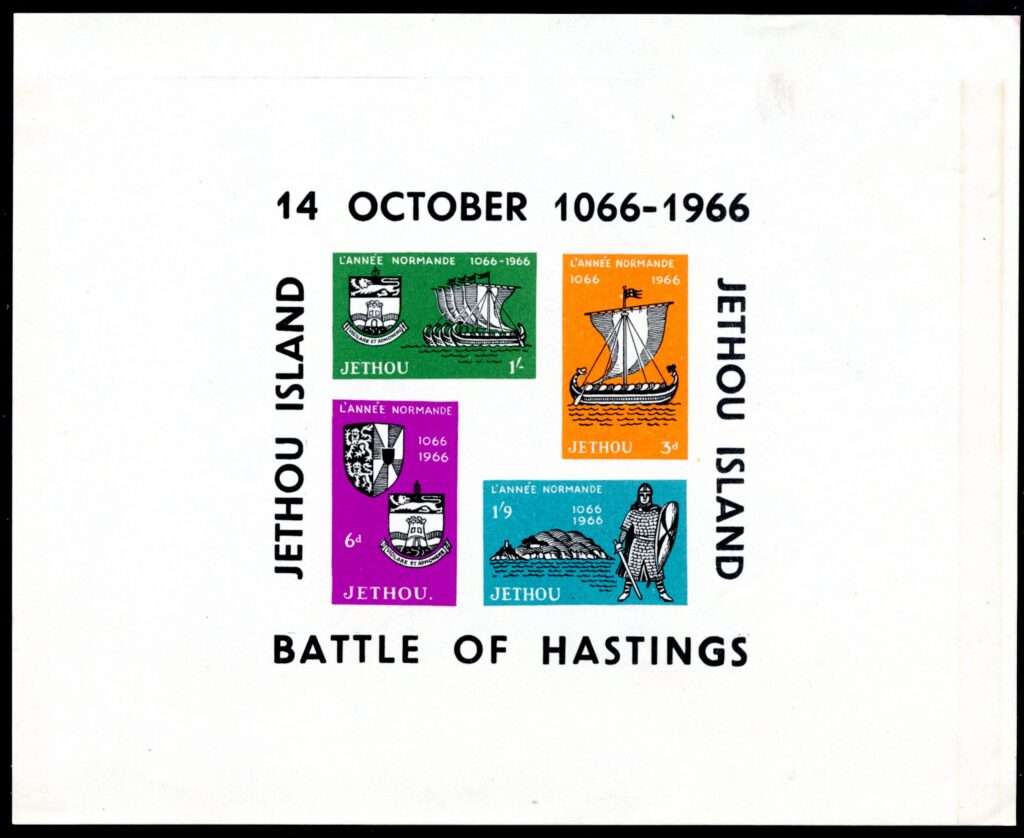
Although the miniature sheet was valid for postage, very few were used on cover and no first day covers exist, although it is known on a plain sheet of paper with a perforated set and first day cancel. Here is a rare example of a postally used cover, front and back, signed by the designer Charles Coker (Figure 17).